
Introduction
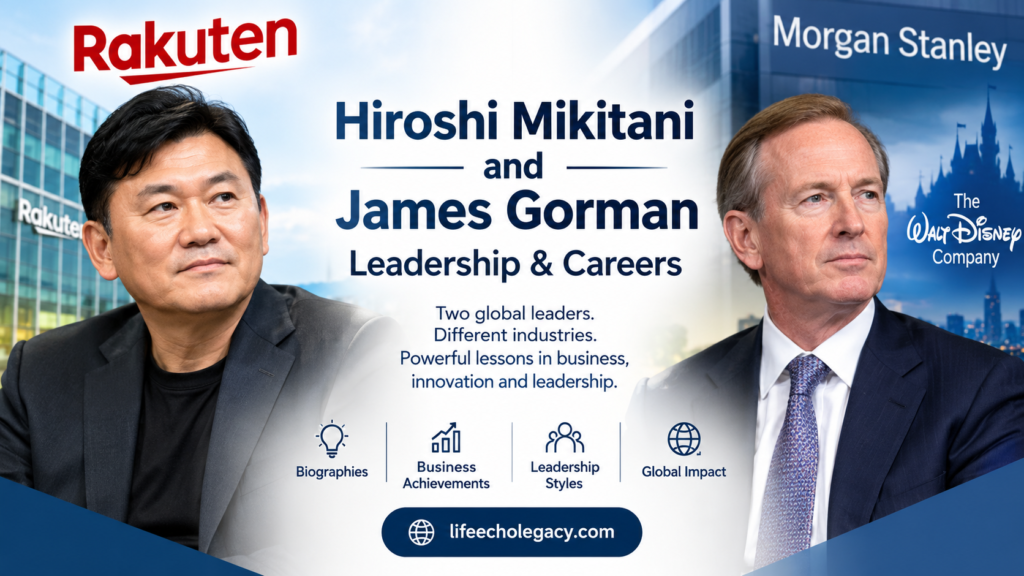
Hiroshi Mikitani and James Gorman are two prominent business leaders whose careers offer valuable insights into entrepreneurship, corporate strategy, and global business leadership. While Mikitani is best known for founding Rakuten Group, Gorman gained international recognition for leading Morgan Stanley and later becoming Chairman of The Walt Disney Company.
Although they have worked in different industries, their professional journeys highlight important lessons about innovation, organizational growth, strategic decision-making, and leadership succession. Understanding their backgrounds also helps explain why people compare Hiroshi Mikitani and James Gorman when researching influential executives.
Who Is Hiroshi Mikitani?
Early Life and Education
Hiroshi Mikitani is a Japanese entrepreneur and business executive born on March 11, 1965, in Kobe, Japan. His educational background includes studying at Hitotsubashi University before earning an MBA from Harvard Business School in 1993.
Before becoming an entrepreneur, Mikitani worked in banking, where he gained experience in financial services and business management. This professional foundation helped him develop the commercial knowledge and strategic perspective that later influenced his entrepreneurial career.
Founding Rakuten Group
In 1997, Mikitani founded the business that became Rakuten Group, initially focusing on online shopping through Rakuten Ichiba. At a time when online shopping was still developing in Japan, his approach centered on helping independent merchants reach customers through the internet.
Over time, Rakuten expanded beyond e-commerce into financial technology, travel, digital content, communications, and mobile services. According to Rakuten’s official corporate information, its global ecosystem encompasses more than 70 businesses and reaches approximately 2.1 billion people worldwide.
Hiroshi Mikitani’s Leadership Style
Mikitani’s leadership philosophy emphasizes innovation, entrepreneurship, experimentation, and communication. Rather than limiting Rakuten to a single business category, he has pursued a connected ecosystem in which customers can access multiple services through the broader Rakuten network.
From a business strategy perspective, this model demonstrates how customer loyalty and cross-service integration can support expansion. However, managing a diversified organization also requires substantial investment, effective coordination, and careful evaluation of each business’s financial performance.
Who Is James Gorman?
Early Life and Professional Background
James P. Gorman is an Australian-born business executive known for his leadership in the global financial services industry. He earned undergraduate and law degrees from the University of Melbourne before completing an MBA at Columbia University.
Gorman began his career as an attorney and subsequently moved into management consulting at McKinsey & Company. He later held senior executive positions at Merrill Lynch before joining Morgan Stanley in 2006.
Leadership at Morgan Stanley
Gorman became CEO of Morgan Stanley in January 2010 and served as chairman from January 2012 through December 2023. During his tenure, he helped reshape the financial institution, placing significant emphasis on wealth management, investment management, organizational integration, and long-term strategic development.
Morgan Stanley’s official leadership retrospective describes his 14-year CEO tenure as a period of significant transformation. The company’s strategic development included expanding its wealth management operations and strengthening its position across different financial services businesses.
James Gorman’s Current Role
James Gorman’s responsibilities have evolved since his time as Morgan Stanley’s chief executive. He became Executive Chairman in January 2024 and Chairman Emeritus in January 2025.
As of October 2026, Gorman serves as Chairman of The Walt Disney Company’s Board of Directors. His current position highlights the importance of corporate governance, strategic oversight, and executive succession rather than the day-to-day management of a financial institution.
Hiroshi Mikitani and James Gorman: Key Differences
Comparing Their Careers and Achievements
Although both executives have influenced major international organizations, their career paths are fundamentally different. Mikitani built and continues to lead a company he founded, whereas Gorman advanced through established financial institutions before becoming the chief executive of Morgan Stanley.
Their experiences demonstrate that successful leadership does not follow a single formula. Entrepreneurs often concentrate on developing new markets and business models, while professional executives may focus on transforming established organizations, managing risk, and maintaining institutional stability.
| Comparison | Hiroshi Mikitani | James Gorman |
|---|---|---|
| National background | Japanese | Australian-born |
| Best known for | Founding Rakuten Group | Leading Morgan Stanley |
| Main industry | E-commerce and digital services | Financial services and corporate governance |
| Career path | Entrepreneur and founder | Professional executive |
| Major leadership focus | Innovation and business expansion | Institutional transformation and succession |
| Current position | Chairman, President and CEO of Rakuten Group | Chairman of Disney’s Board; Chairman Emeritus of Morgan Stanley |
Business Strategy and Decision-Making
Mikitani’s business strategy focuses on creating connections between digital services. E-commerce, fintech, communications, and other businesses can potentially reinforce one another by improving customer convenience and encouraging repeat engagement.
Gorman’s leadership at Morgan Stanley followed a different strategic direction. His work involved strengthening an established financial institution, expanding wealth management, and preparing the organization for a leadership transition. These contrasting approaches illustrate how business strategy must reflect a company’s industry, competitive environment, and long-term objectives.
What Connects Hiroshi Mikitani and James Gorman?
Their Shared Interest in Global Business Leadership
Hiroshi Mikitani and James Gorman are frequently discussed together in the context of international business leadership. Both have held influential positions in large organizations and have been associated with strategic decisions affecting their respective industries.
However, their careers should not be confused with a confirmed personal partnership. Publicly available corporate biographies do not establish that the two executives jointly founded a company, served as business partners, or maintained a direct personal relationship.
The Importance of Understanding Their Corporate Connection
When researching two prominent executives, it is important to distinguish between a documented institutional connection and a personal business relationship. Financial institutions may participate in transactions involving a company without their chief executives personally negotiating or managing those transactions.
For readers researching Hiroshi Mikitani and James Gorman, this distinction provides a more accurate understanding of their professional backgrounds. Their comparison is most useful when examining leadership models, corporate strategy, and the responsibilities associated with running multinational organizations.
Leadership Lessons From Hiroshi Mikitani and James Gorman
1. Innovation Requires Long-Term Commitment
Mikitani’s development of Rakuten demonstrates how a company can evolve beyond its original business model. Expanding into additional services requires a clear strategy, customer understanding, and the willingness to adapt as markets change.
Entrepreneurs can learn from this approach by evaluating whether new products genuinely complement their existing businesses. Expansion alone does not guarantee success; new initiatives must create value for customers while remaining financially sustainable.
2. Organizational Transformation Requires Strategic Discipline
Gorman’s Morgan Stanley career illustrates the importance of adapting an established institution to changing business conditions. Strategic transformation can involve acquisitions, adjustments to business priorities, operational improvements, and investment in areas with long-term potential.
Business leaders can apply this lesson by evaluating existing operations objectively and identifying where resources are most effective. Sustainable growth depends on more than increasing revenue; it also requires sound risk management and responsible capital allocation.
3. Leadership Succession Matters
One of the most important lessons from Gorman’s career is the value of preparing an organization for its next leader. Morgan Stanley announced in October 2023 that Ted Pick would become CEO on January 1, 2024, allowing the company to plan for a structured leadership transition.
For founders and executives, succession planning helps reduce uncertainty and protects institutional knowledge. It also allows organizations to develop future leaders before a leadership change becomes necessary.
4. Company Culture Influences Performance
Mikitani’s emphasis on entrepreneurship and communication reflects the role organizational culture can play in innovation. Employees need an environment where ideas can be discussed, tested, and evaluated against business objectives.
Gorman’s experience at a major financial institution highlights another side of corporate culture: accountability, client relationships, governance, and risk awareness. The most effective culture depends on the organization’s purpose, but it must consistently support responsible decision-making.
Challenges and Considerations in Their Leadership Models
The Opportunities and Risks of Founder-Led Businesses
Founder-led companies can benefit from a clear vision and continuity in strategic decision-making. Mikitani’s long-term involvement at Rakuten provides an example of how a founder can guide a business through multiple stages of development.
However, diversification can introduce complexity, financial pressure, and competing priorities. A company operating across several industries must evaluate each business independently while ensuring that its overall strategy remains coherent.
The Responsibilities of Leading Established Institutions
Leading a mature financial institution involves a different set of challenges. Executives must balance growth opportunities with regulatory obligations, client expectations, operational resilience, and financial risk.
Gorman’s experience illustrates the importance of coordinating different business units while maintaining institutional trust. His transition from CEO to board-level leadership also shows that executive responsibilities can change as an organization moves into a new stage.
Frequently Asked Questions
Are Hiroshi Mikitani and James Gorman business partners?
No direct personal or business partnership between them has been established in the corporate biographies reviewed. Mikitani is associated with Rakuten Group, while Gorman is known for his leadership at Morgan Stanley and his role at Disney.
What company did Hiroshi Mikitani found?
Hiroshi Mikitani founded the business that became Rakuten Group in 1997. The company subsequently expanded into e-commerce, financial technology, communications, and other digital services.
Is James Gorman still the CEO of Morgan Stanley?
No. Gorman served as Morgan Stanley’s CEO from January 2010 through December 2023. He became Executive Chairman in 2024 and Chairman Emeritus in January 2025.
What does James Gorman do in 2026?
As of October 2026, James Gorman serves as Chairman of The Walt Disney Company’s Board of Directors and Chairman Emeritus of Morgan Stanley.
What is the biggest difference between Hiroshi Mikitani and James Gorman?
Mikitani is an entrepreneur who founded and continues to lead Rakuten Group. Gorman is a professional executive whose career is associated with transforming Morgan Stanley and overseeing leadership succession before moving into board leadership.
What can business owners learn from their careers?
Business owners can learn the importance of innovation, disciplined growth, organizational culture, and succession planning. Their experiences also demonstrate why leadership strategies should be adapted to the organization’s industry, size, and stage of development.
Conclusion
Hiroshi Mikitani and James Gorman represent two distinct approaches to global business leadership. Mikitani’s career centers on entrepreneurship, digital innovation, and building an interconnected business ecosystem through Rakuten Group.
Gorman’s professional journey highlights institutional transformation, financial services strategy, corporate governance, and leadership succession. Although their careers do not establish a direct personal partnership, comparing them provides useful insights into how different leadership models can shape large organizations.
For entrepreneurs, executives, and business students, the key lesson is that sustainable success requires a combination of strategic thinking, responsible decision-making, adaptability, and a clear understanding of long-term business objectives. Visit my site